 DipGrid
How Far Apart Should You Space Buy Orders When Buying a Dip?
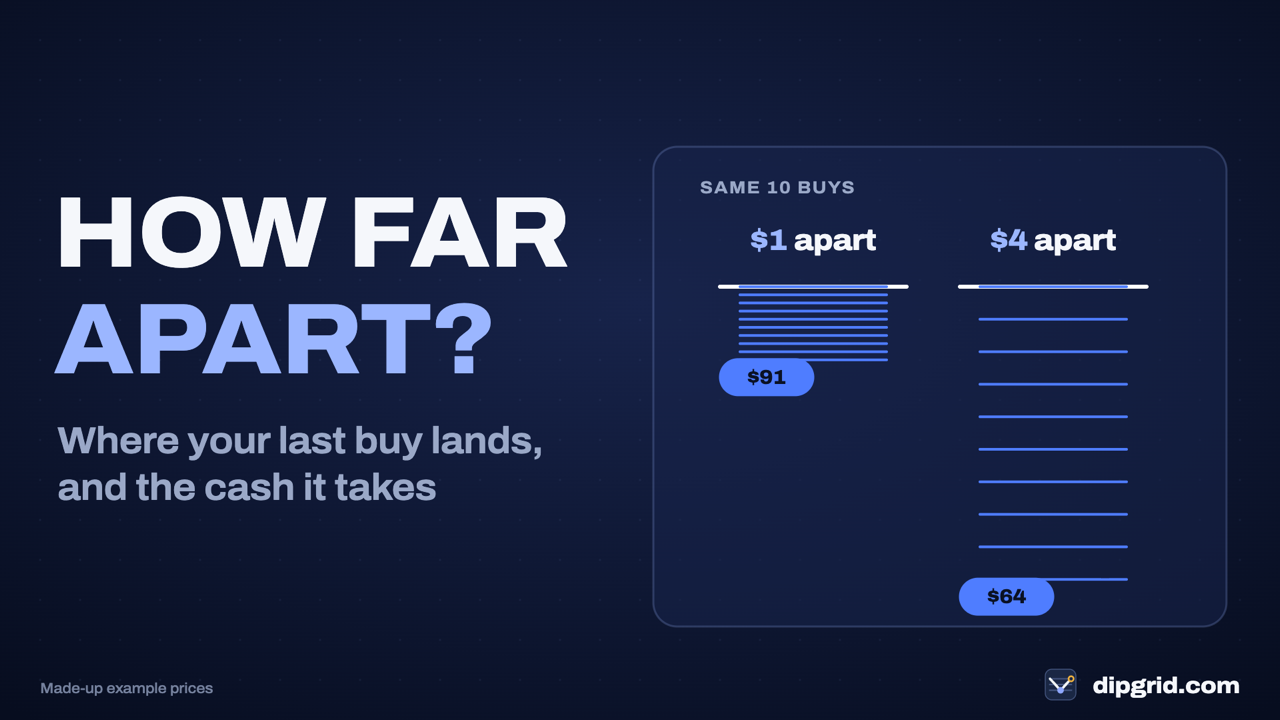
You want to buy a stock if it drops, so you line up a few limit orders at and below today's price. Then comes the question nobody answers in the order screen: how far apart should they be?
The gap decides how often you sell, how big each sale is and how deep the ladder reaches before the cash runs out. This guide shows how to pick it. Every price below is made up.
Key takeaways
- A narrow gap sells more often but earns less each time, and the cash runs out on a shallow drop.
- A wide gap sells less often and earns more each time, and it reaches much deeper for the same number of buys.
- Before you place anything, work out where your last buy would fill and how much cash the whole ladder needs.
Dollars or percent
You can set the gap in dollars, like $1, or in percent, like 1%. On a $100 stock they are the same thing.
The moment the stock isn't at $100, they split. One percent of $100 is $1. One percent of $20 is $0.20, and one percent of $400 is $4. A fixed $1 gap is huge on the $20 stock and tiny on the $400 one.
Percent keeps the ladder the same shape on any price. Dollars are easier to read, and the profit per share is simply the gap. Pick one and stay with it.
Start from how far the stock moves
A good gap fits the stock's ordinary day. Look at a chart and see how far it usually travels between its high and low on a normal day. Say a made-up stock at $100 usually moves about $2.
A $1 gap sits inside that range, so a normal day can fill a buy and sell it again. A $4 gap sits well outside it. The price has to make a bigger move before anything happens, which can take days.
A good first guess is about half the stock's normal daily move, and you adjust from there.
A narrow gap
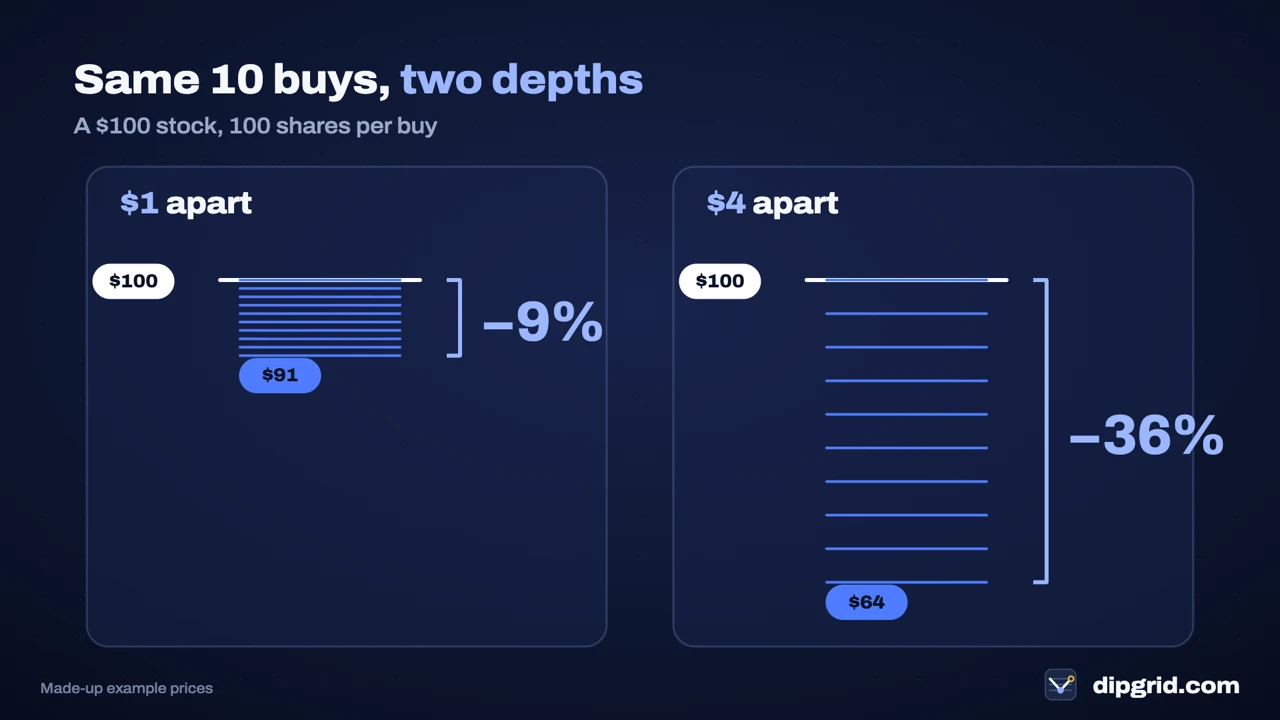
Take a $100 stock and cash for 10 buys of 100 shares each, with the first buy at $100 and the rest $1 apart. The buys fill at $100, $99, $98 and so on down to $91.
Each share sells one step above where it was bought. A buy and its sale make one round trip, and it earns the gap times the shares: $1 × 100 shares is $100. Small, and it can come around often.
The ladder is shallow, though. The last buy sits at $91, only 9% below the first. If the stock drops 12%, all ten buys are filled, the cash is gone, and the rest of the fall happens without you.
A wide gap
Same stock, same 10 buys of 100 shares, but now $4 apart: $100, $96, $92, $88, $84, $80, $76, $72, $68 and $64.
A round trip now earns $4 × 100 shares, which is $400. There are fewer of them, because the price has to swing further to fill a buy and reach its sale.
The last buy sits at $64, which is 36% below the first. Same number of orders, four times the depth.
How deep will your last buy go
You don't have to draw the ladder to find out. Two lines are enough.
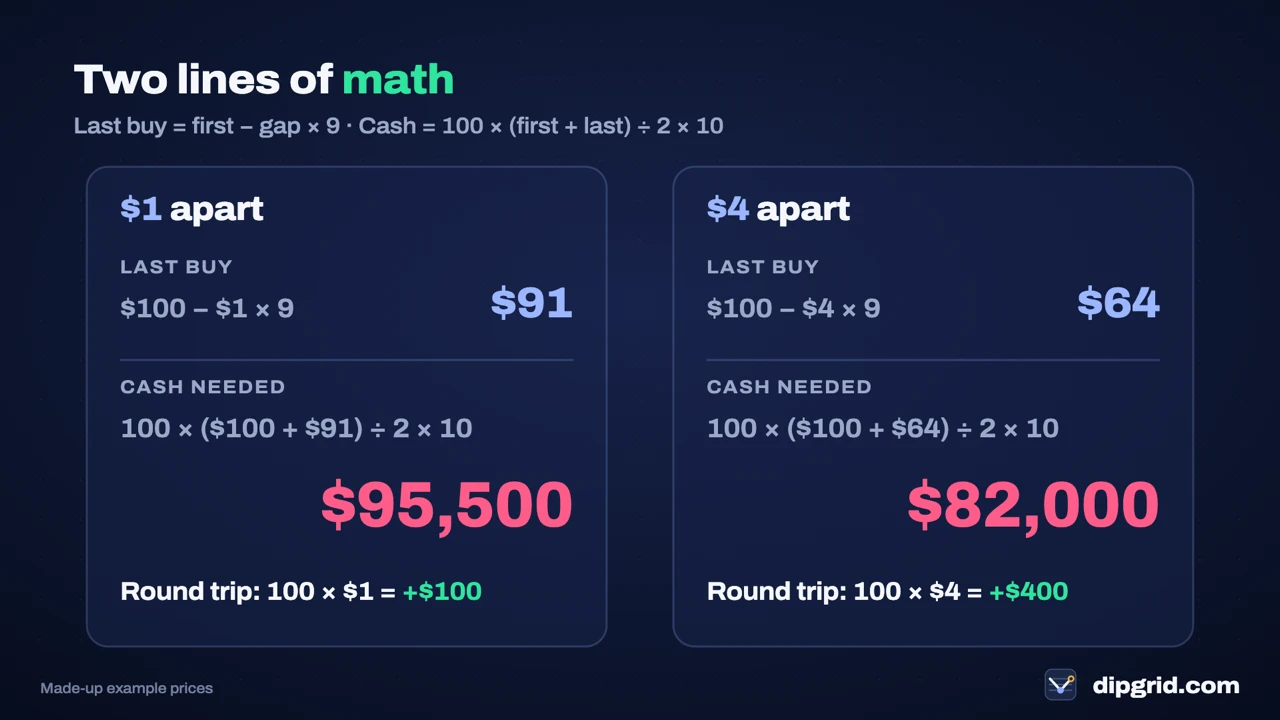
Last buy price = first buy price − gap × (number of buys − 1)
Cash needed = shares per buy × (first price + last price) ÷ 2 × number of buys
Check them on the narrow ladder. The last buy is $100 − $1 × 9, which is $91. The cash is 100 × ($100 + $91) ÷ 2 × 10, which is $95,500.
The wide ladder: the last buy is $100 − $4 × 9, which is $64. The cash is 100 × ($100 + $64) ÷ 2 × 10, which is $82,000.
The wide ladder needs less money, because its later buys fill at lower prices. If you'd rather not do the arithmetic, the buy-the-dip calculator adds it up for any plan.
Choosing the depth first
Start from a different question. Look at how far this stock has dropped in rough months before, and ask where you'd be glad to still be buying.
Say you want the ladder to reach about 20% down. With 10 buys on a $100 stock, that's a last buy around $80, so $20 over 9 gaps. A gap of $2 gets you to $82, and $2.50 gets you to $77.50. Then check the cash. If you can't cover it, cut the shares per buy or the number of buys. Narrowing the gap won't help: it makes the ladder shallower and the bill bigger.
Expensive stocks and cheap ones
A $400 stock with a 1% gap is $4 between buys. Ten buys of 100 shares fill from $400 down to $364 and need $382,000. Most people buy fewer shares there. Ten shares per buy needs $38,200, and each round trip earns $4 × 10, which is $40.
A $20 stock with a 1% gap is $0.20 between buys. Ten buys of 100 shares go from $20.00 to $18.20 and need $19,100. A round trip earns $0.20 × 100, which is $20.
The same percent gives the same depth on both, 9%. What changes is the cash and the profit per round trip. Cheap stocks let you hold more shares for the same money, so the shares per buy matter as much as the gap.
Calm stocks and jumpy ones
Put a 0.5% gap on a calm stock that moves about 1% a day and it works well. Round trips come steadily and the ladder is rarely tested.
Put that gap on a stock that moves 4% a day and it can fill eight buys in a morning. Your cash is out early. A gap near 2% suits that stock better, because ordinary swings still give you sales and the ladder reaches deeper.
A bot can keep the ladder
Placing the orders is the easy part. The hard part is staying with the plan on a day when the price keeps falling, and selling each share one step above where it was bought.
A grid bot on DipGrid does this. You set the stock, the first buy, the gap and the shares per buy. It places the ladder under the price, puts a sell order on every share it buys, one step higher, and puts the level back to work after the share sells. It never spends more than the money you give it. It runs on our server and trades in your own brokerage account, so your computer doesn't need to be on.
This bot and others are on dipgrid.com, from $29. You can watch one work on made-up prices there, no sign-up.
Questions people ask
How far apart should buy orders be?
Close enough that a normal day for the stock can fill one, far enough apart that the ladder reaches the depth you want. A good first guess is about half the stock's normal daily move.
How many buy orders should I place?
As many as your cash covers at the depth you chose. Multiply shares by price for each buy and add them up, or let the buy-the-dip calculator do it.
How much money do I need for a ladder of buy orders?
Shares per buy × the average of your first and last price × the number of buys. On a made-up $100 stock, 10 buys of 100 shares, $4 apart, that's $82,000.
Should I use dollars or percent for the gap?
Percent keeps the ladder the same shape on any price. Dollars are easier to read, and your profit per share equals the gap. Both work.
What happens if the price falls below my last buy?
No more buys fill. You hold what you bought, and the sell orders stay where they are. If the price climbs back, each share sells one step above its buy.