 DipGrid
Grid Bot for Stocks: How It Buys the Dips for You
You already know the routine. The price drops. You watch it, you hesitate, you buy, and then you hope. A grid bot for stocks runs that routine by fixed rules, so you can stop staring at the screen. It buys the dips in small steps, and it sells each share one step higher.
It's not a get-rich-quick tool, and it doesn't try to predict anything. It's for investors who play the long game and want their dip buying to follow a plan instead of a mood. The bot doesn't flinch on a red day or get greedy on a green one. It follows the numbers you set. Here is how it works, on made-up prices.
The ladder: levels and the grid step
Picture a ladder drawn across a price chart. Each rung is a price level. The rungs are the same distance apart, and that distance is the grid step.
You pick the stock, the step, and how much money the bot may use. You also choose where the first buy sits, and the other rungs hang one step apart from it.
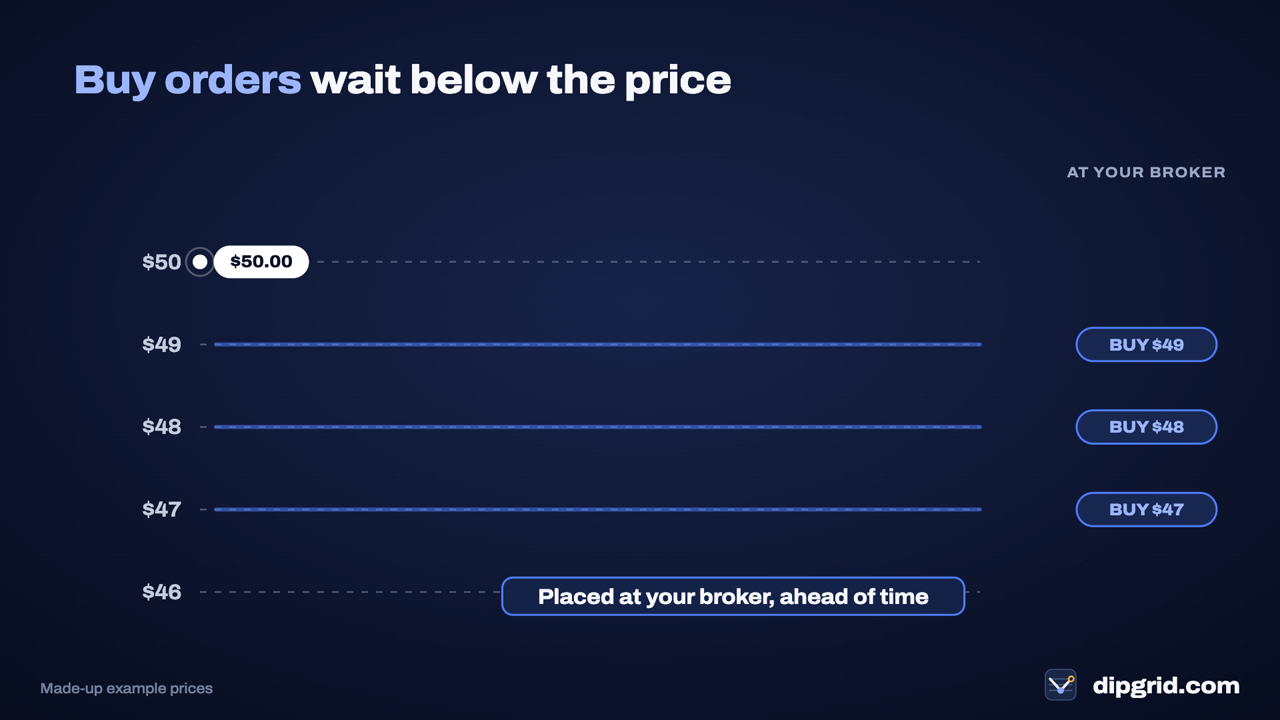
The bot places buy orders on the rungs below today's price. Not one big bet, but a series of small ones. Each order waits for the price to come down to its level.
One trade, from start to finish
Say a stock is at $50 and the step is $1. This is a made-up example, not a recommendation.
The bot waits to buy at $49. The price drops to $49 and the buy goes through. The bot now owns a share, and right away it puts that share up for sale one step higher, at $50.
The price keeps falling. At $48 there's another buy, and another sale waits at $49. A deeper dip just fills more rungs, and each fill is a small position with its own sale waiting one step up. Then the price turns and climbs. The sales go through, one after another. Each share earned $1, before fees and taxes.
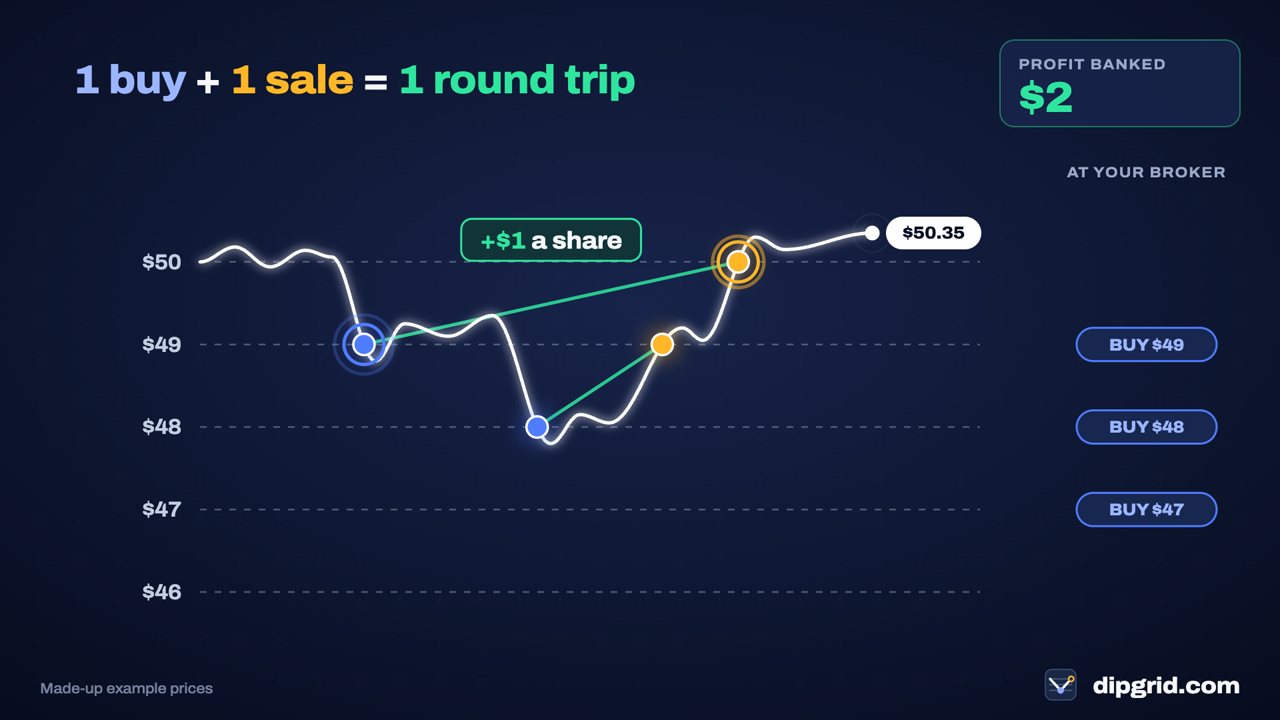
One buy plus its sale is a round trip. And the $49 level is free again, ready to buy if the price comes back down. No forecast. No prediction. Just orders waiting on a ladder.
If you'd rather see it move, watch the 3-minute video. It plays the same trade step by step.
Where a grid is strong, and how to pick the step
A grid likes a market that keeps swinging up and down inside a range. Every swing is another round trip. The more the price zigzags, the more there is to work with.
The step is your choice, in dollars or in percent. On a $50 stock, a $1 step means many small trades. A $5 step means fewer trades, each earning more. Neither is the right answer for everyone. It depends on how far the stock tends to move and how busy you want the bot to be. We don't recommend stocks or settings, so that call is yours.
You can feel the difference on our site. There is a slider for the step, running on made-up prices. Slide it down and the trades multiply. Slide it up and they thin out. Two minutes there says more than another paragraph here.
Why bounces lower your break-even
Here is the part most people miss. Prices rarely fall in a straight line. Even in a long fall, the price bounces.
On every bounce the bot sells a little, then buys the same levels again, lower. Each of those round trips is a small profit, before fees and taxes. And every profit pulls your break-even down.
Your break-even is what the shares you hold cost you, per share, minus the profit the bot has already banked. Here it is with made-up prices. The bot holds two shares, bought at $49 and $48. They cost $97, so your break-even is $48.50 a share.
The price bounces to $49, and the $48 share sells for a $1 profit. Then the price slips back to $48, and the bot buys that level again. You hold two shares again, still $97 at cost, but you banked $1 on the way. Take it off and you're at $96, which makes your break-even $48 a share. Same two shares, same price, and the break-even is 50 cents lower.
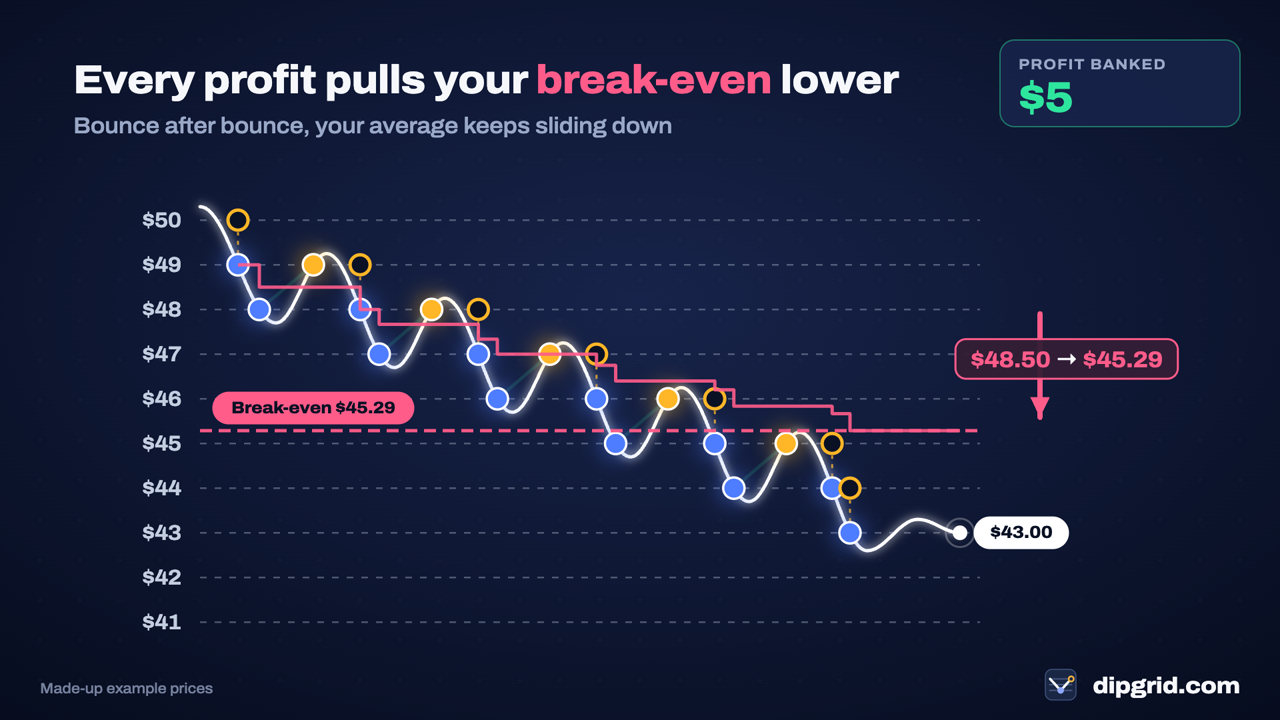
Do this on every bounce and the break-even keeps stepping down. All the bot needs is enough money to keep buying on the way down. That part is yours to set.
You can also let the profit buy more. Then every round trip adds to what the bot can spend, and a deep dip gets bought with money the bot already made. It's a switch, and by default the profit stays set aside in your account.
The bot does the chores, you keep the controls
You could place all of these orders yourself. Some people do. But the work never stops. A buy fills, so you put up the sale. The sale fills, so you put the buy back. Do that across a dozen levels and it becomes a job. The bot does it for you after every buy and every sale, while you're at work or away from the screen. It runs on our server, so your computer doesn't need to be on.
Every number is yours: the stock, the step, the budget. The budget is a cap on what the bot may spend. Pause buying whenever you like. The bot stops new buys and keeps managing the sales for shares it holds. Or stop the bot altogether and choose: keep the shares, or sell them. Optional safety limits are there too, like a price below which the bot places no new buys.
Your money stays at your broker. We never ask for your broker password. DipGrid's access can place and cancel orders. It can't move money out.
Want to see a grid at work? Open dipgrid.com and play with one on made-up prices. No sign-up. Pick a story, slide the step, and watch the bot work the swings.