 DipGrid
Is Grid Trading Profitable? Where the Profit Comes From
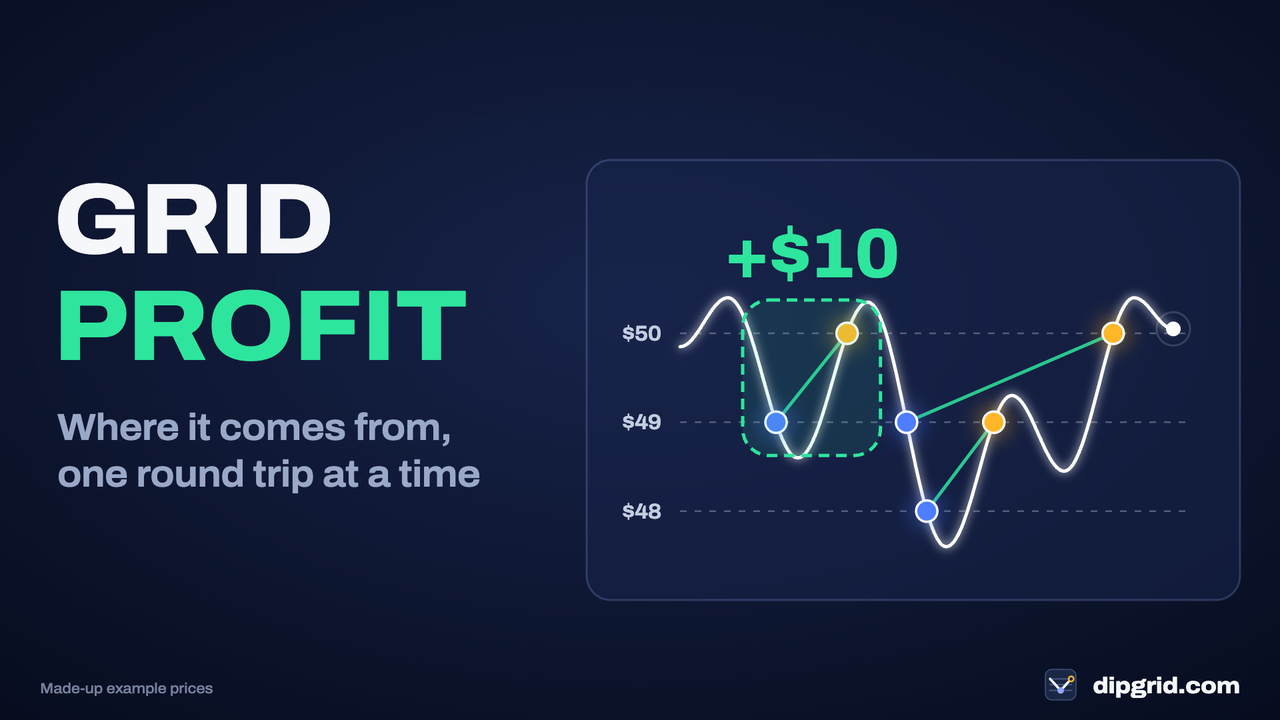
Is grid trading profitable? Every round trip a grid finishes earns a profit by design, because each sale sits one step above its buy. What the grid earns in total depends on how many times the price swings up and down through its levels.
This guide shows where the profit comes from and what moves it. We don't recommend stocks or settings, and everything below uses made-up prices.
Key takeaways
- Five things set the total: how far the price swings, the step, the levels, the shares on each level and the cash behind them.
- Round trip profit comes off what your shares cost, so the price you need to break even drops.
- You can replay your settings on past prices first. The result is hypothetical, and it sits next to buying and holding.
Where a grid's profit comes from
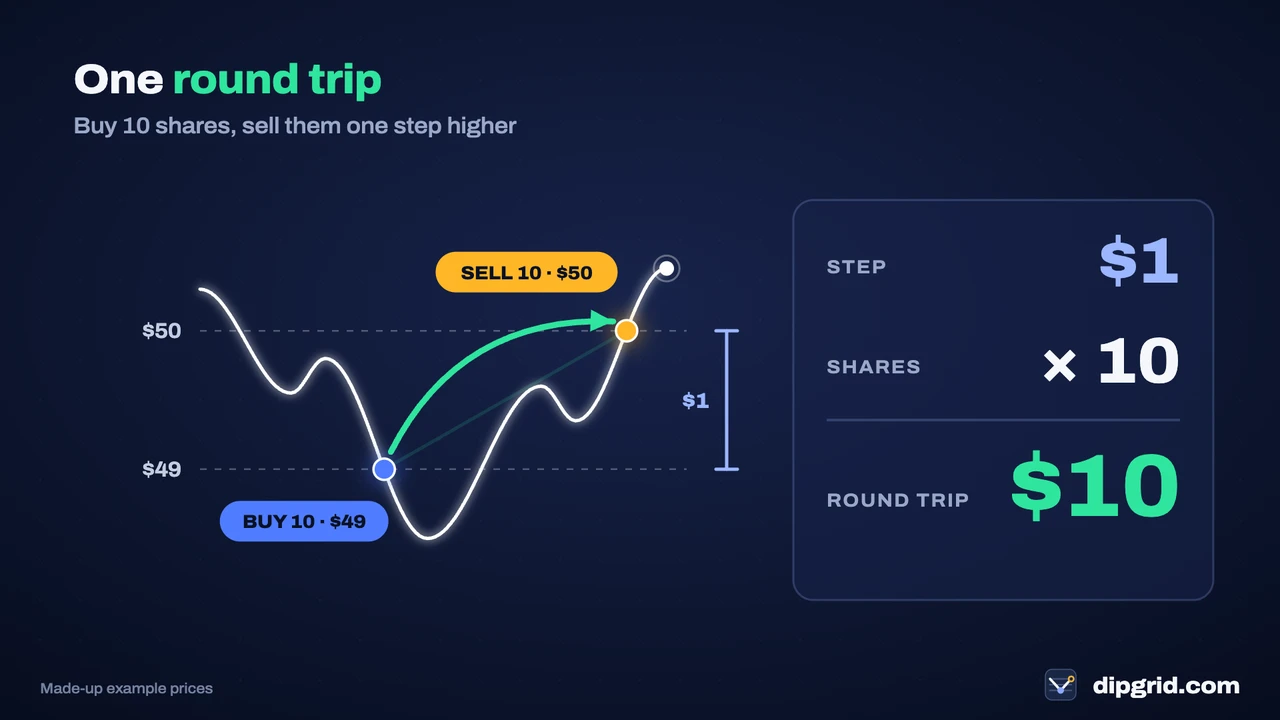
Say a stock trades at $50, your step is $1, and each level holds 10 shares. The price drops to $49 and the buy fills. The bot lists those 10 shares at $50, one step higher. The price recovers, the sale fills, and that's $1 a share, $10 for the round trip.
The $49 level is free again, so the next dip gets bought the same way. Our grid bot guide walks through a first trade step by step.
The profit of one round trip fits in a line:
Profit of a round trip = step × shares
A $1 step on 10 shares is $10. Make it a $2 step, or 20 shares, and it's $20.
What the profit depends on
How far the price swings
A stock that swings up and down all day gives a grid a lot to do. Each dip and recovery is another round trip.
The step
A small step makes many small round trips, and a big step makes fewer, bigger ones. Which one fits depends on how far your stock tends to swing.
The number of levels
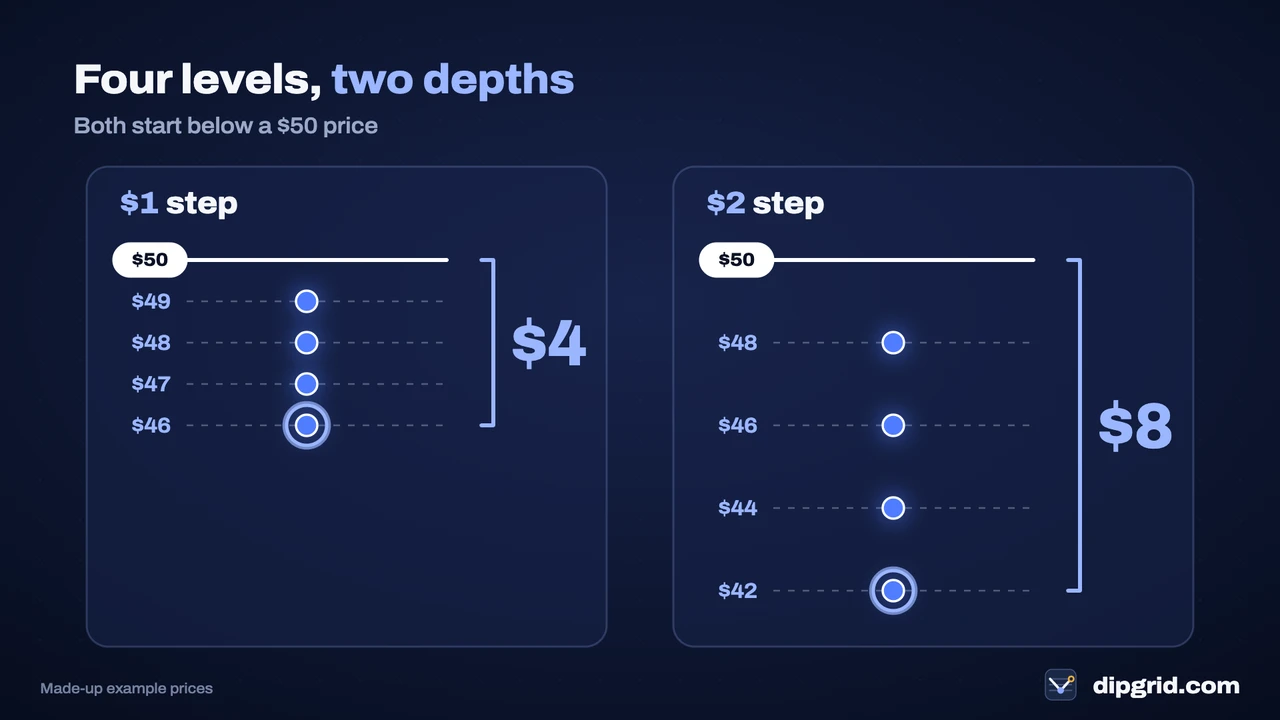
Levels set how far down the grid reaches. Four levels at a $1 step reach $4 below a $50 price, and four at a $2 step reach $8 below it.
The shares on each level
Double the shares on a level and each round trip earns double, and so does the cash that level needs.
The cash
Every level needs cash for its shares: four levels of 10 shares, at $49, $48, $47 and $46, cost $1,900 to fill. Plan the levels for your own stock in our buy-the-dip calculator, which adds up the cash the whole plan needs before you spend any of it.
How round trips lower what your shares cost
This part matters if you plan to keep the shares. Say the bot holds 10 shares bought at $47 and 10 at $46, so 20 shares that cost $930, or $46.50 each. Over a few swings it has finished six round trips of $10, so $60. Take that off and you've paid $870 for 20 shares, or $43.50 each.
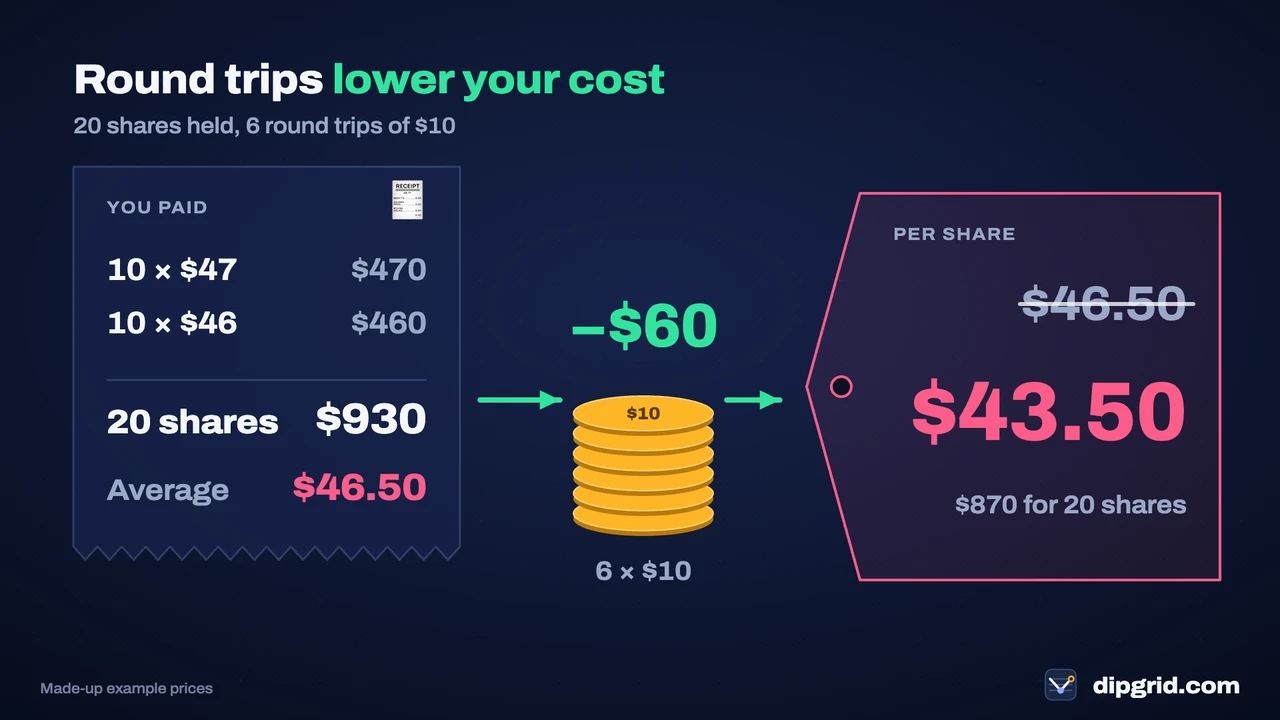
The stock hasn't moved. The price you need to get back to even has, from $46.50 to $43.50, and every further round trip pulls it lower. To see where you're even after fees, type the lowered average and your shares into our break-even calculator.
Averaging down lowers your cost by buying more as the price falls, and a grid does that too. The buying math is in our guide on how to average down a stock to break even.
Try your settings on past prices
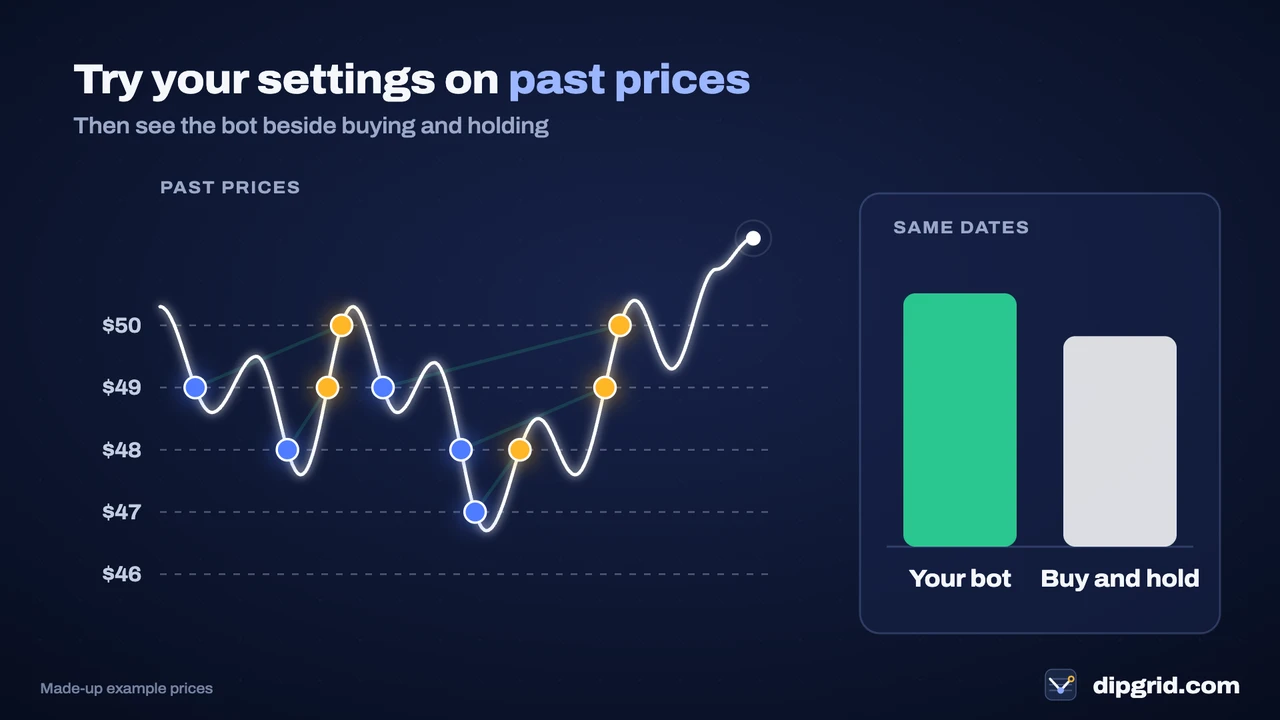
You don't have to guess whether a step suits a stock. In DipGrid, Backtest runs your settings through a stock's past prices and places your bot's orders the way the real bot would. Nothing goes to your broker. Pick the stock and the dates.
The result comes as two estimates. The careful one counts a round trip only when the price clearly dropped and came back later. The generous one also counts swings inside a single stretch of time. Beside them sits the same stock bought and held over the same dates. Every result is marked hypothetical, past prices.
Why stocks suit a grid
Stocks swing every day, and a company you like can be held for years. Pick one you'd be glad to own, and the dips a grid buys are shares you'd want anyway, while each swing back up banks a profit.
A bot runs the grid for you
A grid bot on DipGrid does the order juggling. You set the numbers: the stock, the first buy, the step, the shares on each level and the money for the bot. It places the buys, lists each share one step higher when a buy fills, and puts the level back to work when the share sells. It runs on our server and trades in your own brokerage account, so your computer doesn't need to be on. If your broker allows overnight trading, it can keep working on weeknights too.
This bot and others are on dipgrid.com. You can watch one work on made-up prices there, no sign-up.
Questions people ask
Is grid trading profitable?
You can check it for your own stock before you start. Backtest runs your step and shares through that stock's past prices and puts the result beside buying and holding. The result is marked hypothetical, past prices, and it lets you compare two setups on the same dates.
Does grid trading work on stocks, or only on crypto?
It works on stocks too. A grid is orders waiting at set prices, so any market whose price swings up and down gives it round trips. DipGrid bots are built for US stocks and trade in your own brokerage account.
How do I choose the grid step?
Look at how far your stock usually swings in a day or a week. A step well inside that range makes round trips often, and a wider one waits for the big swings.
How much money does a grid bot need?
Enough to fill the levels you want. Add up shares times price for every level, or let the buy-the-dip calculator do it for any plan. The bot never spends more than the money you give it.
Does grid trading work in a sideways market?
A sideways market is the best case for a grid. The price swings up and down through the same levels again and again, and each dip and recovery is another round trip.