 DipGrid
Averaging Down vs Scaling In: A Plan or a Hope?
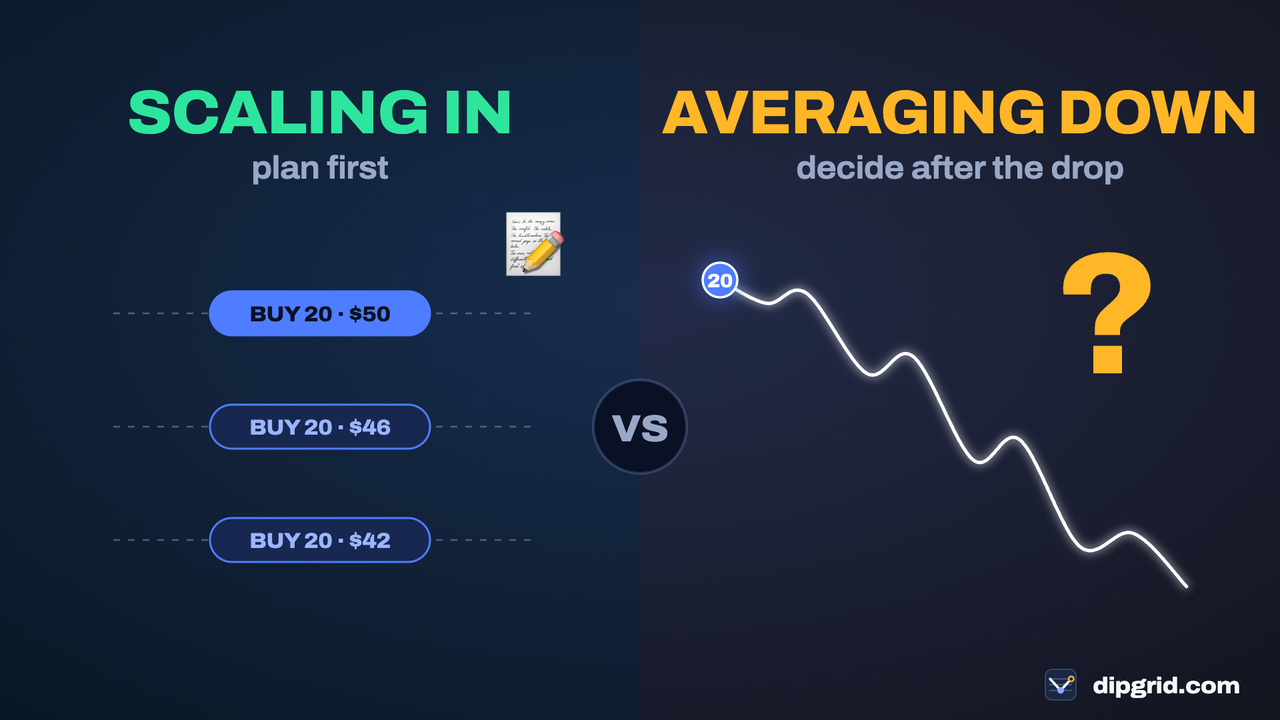
On your screen they look the same: the stock drops, you buy more. The difference is when you made the call.
Key takeaways
- Scaling in means you plan the whole position, and the prices, before the first buy.
- Averaging down usually means you decide to buy more after the price has already fallen.
- On paper the average can match. What doesn't match is how much cash you've committed and where you stop.
Scaling in: the plan comes first
Scaling in means you decide the whole position before the first buy and split it into parts. You buy one part now, and the rest waits at prices you picked in advance.
A made-up example, not a recommendation. You want 60 shares of a $50 stock. You plan 20 now at $50, 20 at $46 and 20 at $42. The full plan costs $2,760: $1,000, then $920, then $840. If all three parts fill, your average is $46.
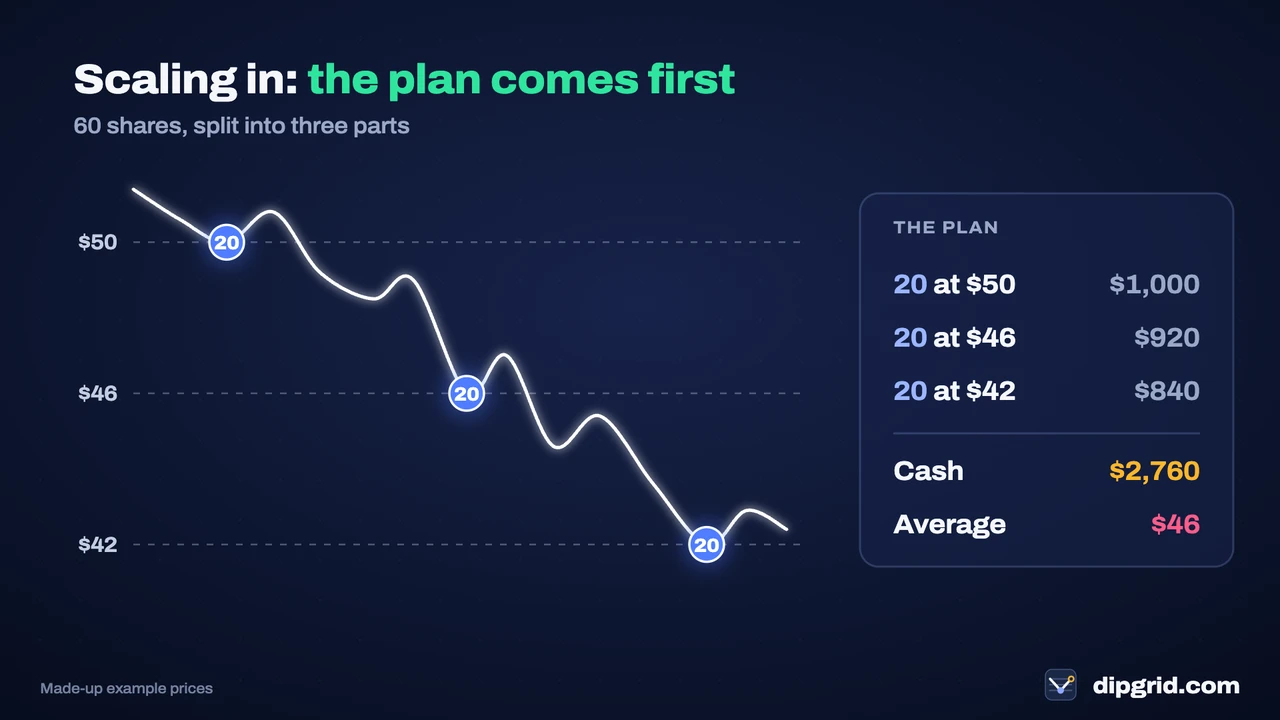
If the price never drops and only the first part fills, you own fewer shares than you wanted, and the rest just stays in cash. If it slides to $42, you end up with the 60 shares you planned, paid for with cash you'd already put aside.
In this example, $42 is the bottom of the plan. Below it you stop buying, hold what you have, and ask whether your reason for owning the stock still holds.
Averaging down: the decision comes after the drop
Averaging down usually starts with a buy that was meant to be the only one. You bought 20 shares at $50. At $46 it looks cheap, so you buy 60 more with whatever cash happens to be there. Now you hold 80 shares at a $47 average, $3,760 in, and you're hoping that was the bottom. When it slides to $42, there's nothing left to buy with.
This is where people get hurt. The other common version goes the opposite way: you freeze, buy nothing, and watch it bounce back without you.
Three questions that tell them apart
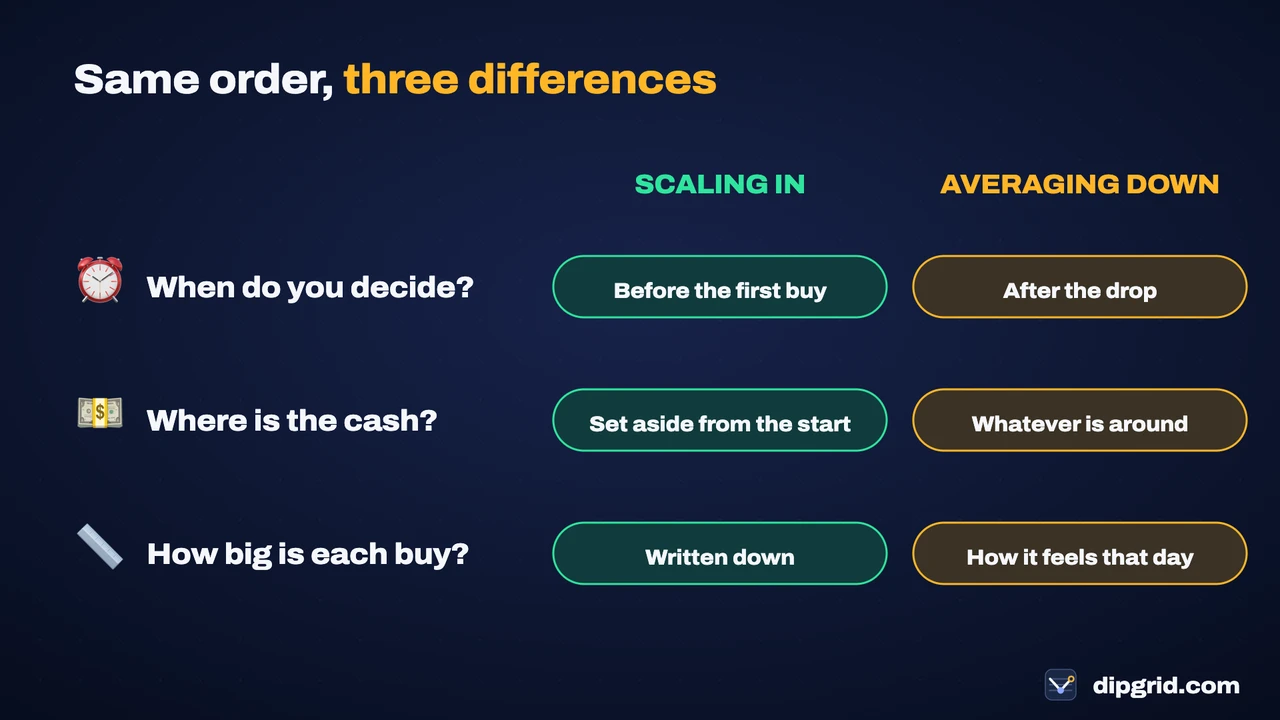
When did you decide, where did the cash come from, and how big was each buy? If you can't answer these before the stock drops, you're averaging down on the spot.
Averaging down vs DCA
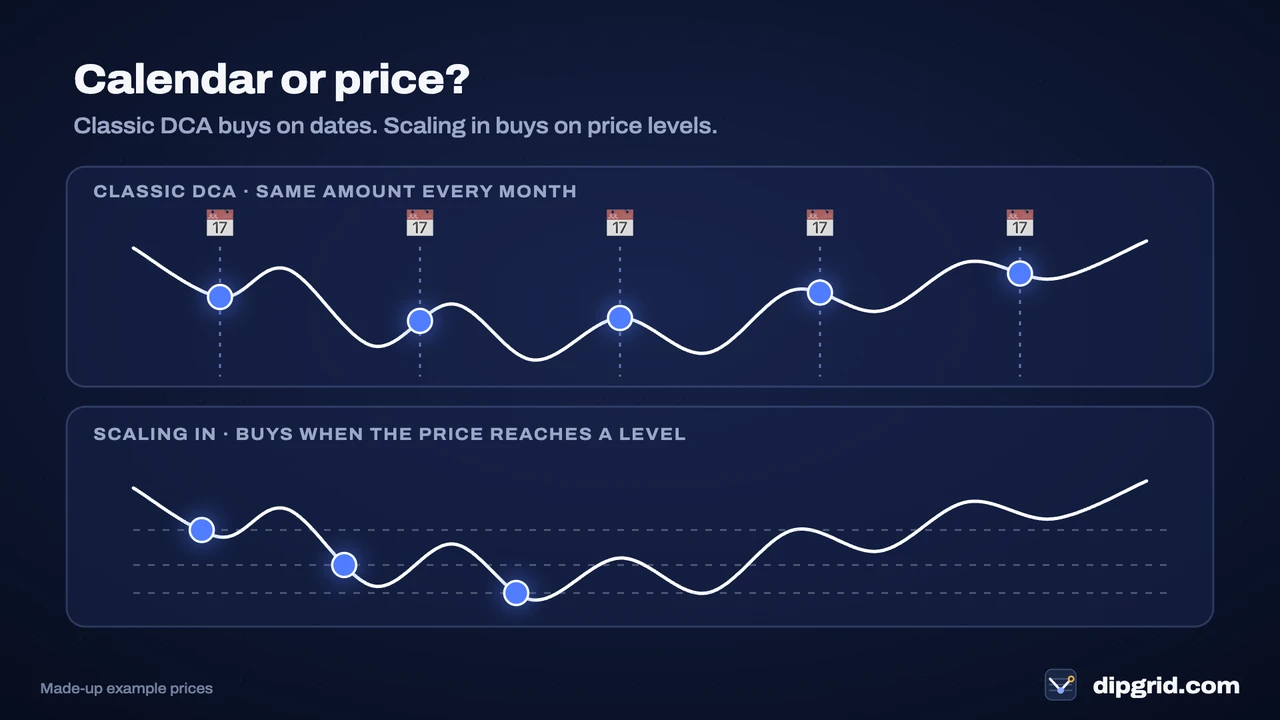
Classic dollar-cost averaging, or DCA, follows the calendar. It buys the same dollar amount every week or month, whatever the price. Scaling in and averaging down follow the price: you buy because it fell.
Turning a dip into a plan
Before the first buy, write down the prices where you'll add, the shares at each, the lowest price you'll go to, and the total cash the plan needs. Then keep that cash aside. If you'd like the math worked out step by step, our guide on how to average down a stock to break even does it with three buys and shows how fast the cash adds up.
A bot can keep the plan for you
The total a bot can spend is fixed before it starts. That's the plan, enforced. It trades in your own brokerage account, we never ask for your broker password, and it can't move money out. If your broker allows overnight trading, it can keep working on weeknights too.
A grid bot keeps buy orders waiting at set prices below today's price. Each share it buys goes up for sale one step higher, so on each bounce big enough to reach the next step, it sells a little and is ready to buy again. A DCA bot on DipGrid scales in: a first buy, then more shares at steps you set, and it sells everything it bought once the price climbs a set percent above its average. Bot apps call it a DCA bot, even though it buys on price drops, not on dates.
These bots and others are on dipgrid.com. You can watch a grid work on made-up prices there, no sign-up.
Questions people ask
Is scaling in the same as averaging down?
Both mean buying more as the price falls. Scaling in is planned before the first buy. Averaging down is usually decided after the drop.
Does scaling in mean adding to winners?
Traders use it both ways. Scaling into a winner means adding as the price rises. Scaling in on the way down means buying a planned position in steps as the price falls.
Is averaging down the same as dollar-cost averaging?
No. Classic dollar-cost averaging buys a fixed amount on a schedule, whatever the price. Averaging down buys because the price fell below what you paid.
What is averaging up?
Buying more shares as the price rises above what you paid. Your average cost goes up, but so does the size of a position that's already working.
Can a bot scale in for me?
Yes. A grid bot or a DCA bot places buys at prices you set ahead of time, so the plan fills without you watching the screen.