 DipGrid
How to Average Down a Stock to Break Even
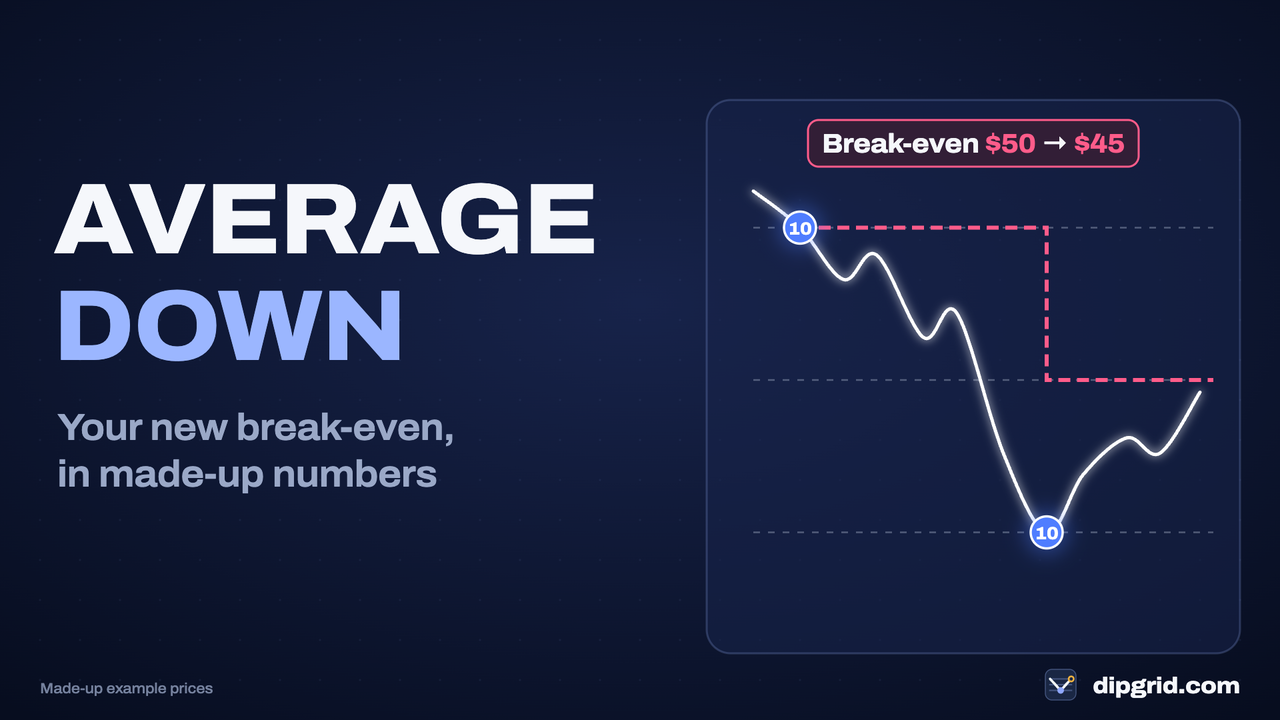
Your stock is down 20%, and you're wondering whether buying more lowers the price you need to break even. It does. Whether to buy is your call, and we don't recommend stocks. But the math fits on a napkin.
Before the math, ask yourself one thing: would you buy this stock today, at this price, if you didn't already own it? If the answer is yes, read on. Everything below uses made-up prices.
Key takeaways
- Your average cost is what you paid divided by the shares you hold. Fees aside, it's your break-even.
- Buying lower pulls the average down, so the stock needs a smaller bounce to get you back to even.
- The lower you want your average, and the closer to today's price, the more cash it takes.
How averaging down works
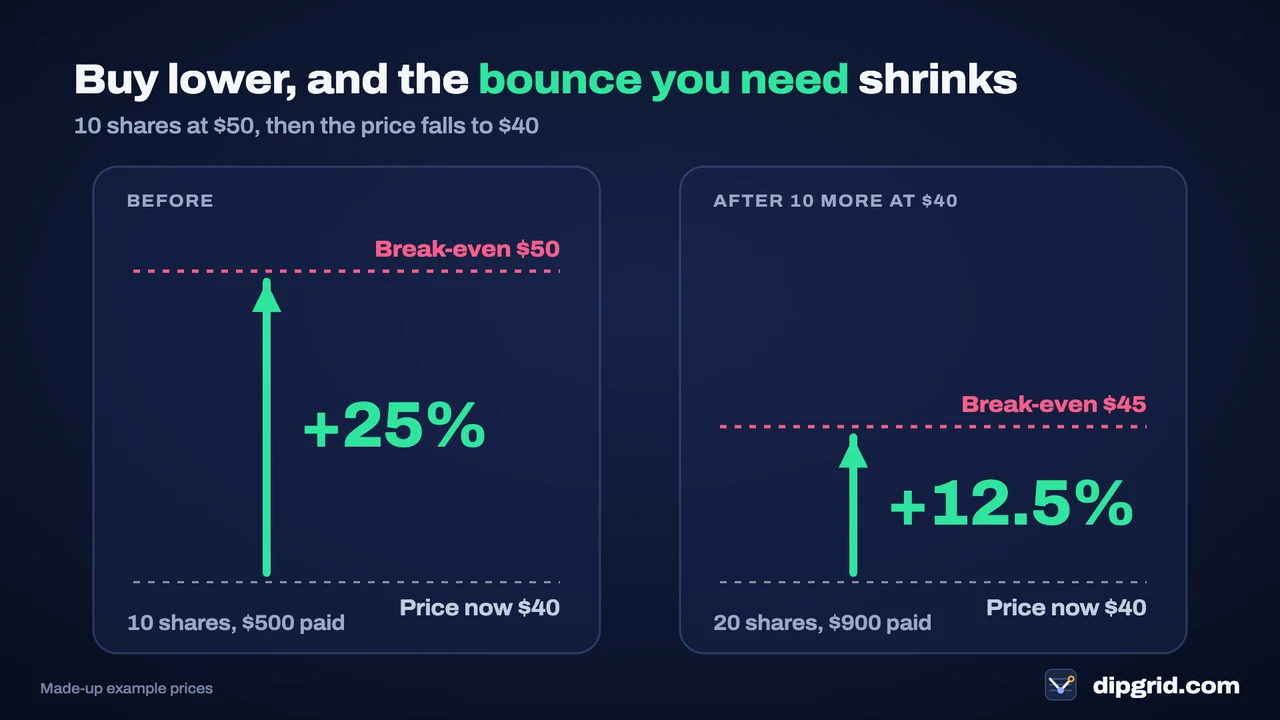
Say you bought 10 shares at $50. You paid $500, so your break-even is $50. Then the price drops to $40. To get back to even, the stock has to climb 25%.
Now you buy 10 more shares at $40, for $400. You hold 20 shares that cost $900, so your average is $45. At $45 you're even, and from $40 that's a climb of 12.5%.
How many shares to buy for the average you want
Most people come at it from the other end. They pick the average they'd like and ask how many shares that takes. Here's the formula:
Shares to buy = shares you hold × (your average − target average) ÷ (target average − today's price)
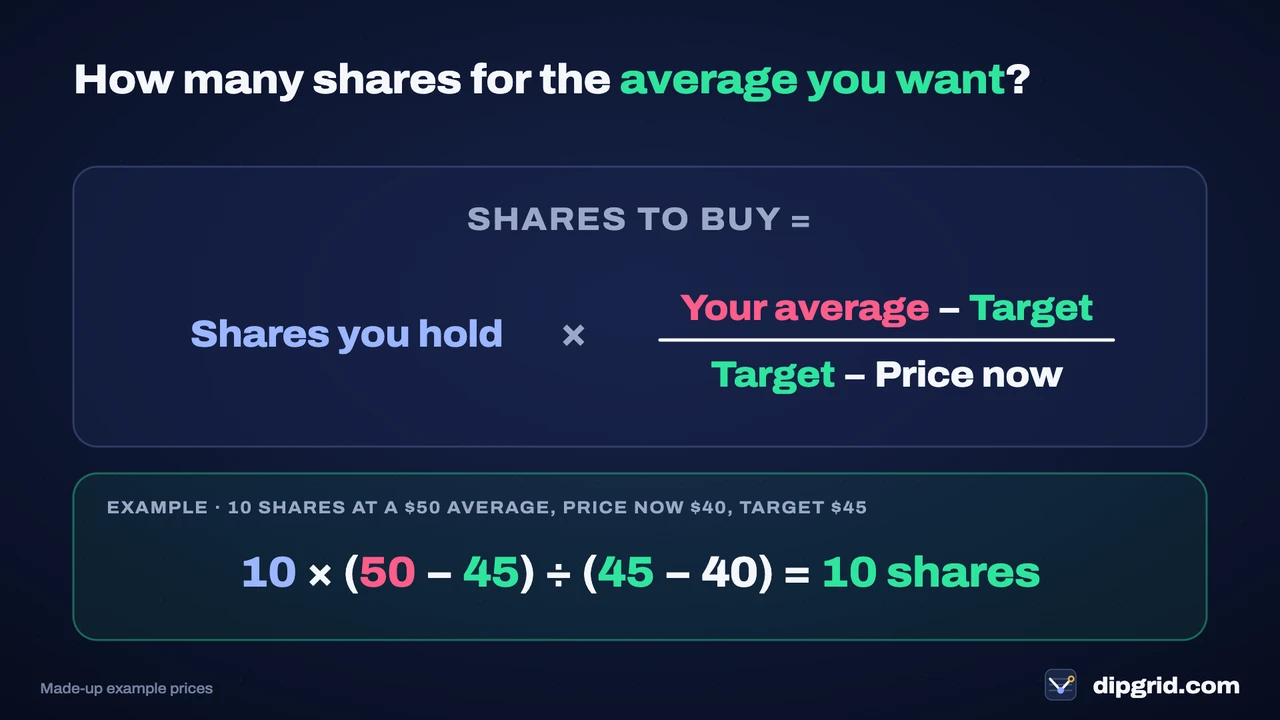
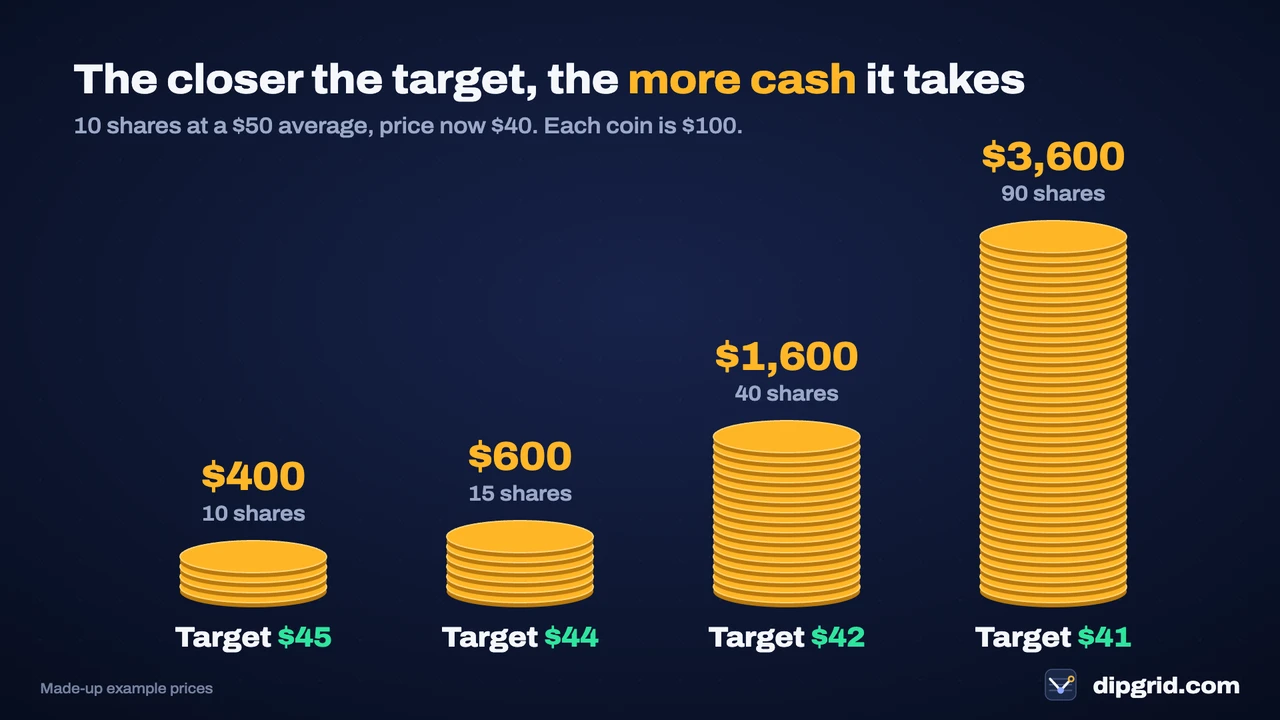
Back to the example. You hold 10 shares at a $50 average, and the price is $40. For a $45 average: 10 × (50 − 45) ÷ (45 − 40) = 10 shares. That's the $400 buy from above.
Now aim for $42: 10 × (50 − 42) ÷ (42 − 40) = 40 shares, or $1,600 at $40. Check it: $500 plus $1,600 is $2,100 for 50 shares, which is $42 each.
Your target has to sit above today's price. You can get close to it, but never all the way, and the closer you get, the faster the bill grows. A $41 target already takes 90 shares, or $3,600.
Three buys, step by step
If you haven't bought yet, or you're planning your next stock, here's what a plan with three buys looks like, each one bigger than the last:
- 10 shares at $50, for $500.
- 15 shares at $45, for $675. Now 25 shares cost $1,175, an average of $47.
- 20 shares at $40, for $800. Now 45 shares cost $1,975, an average of $43.89.
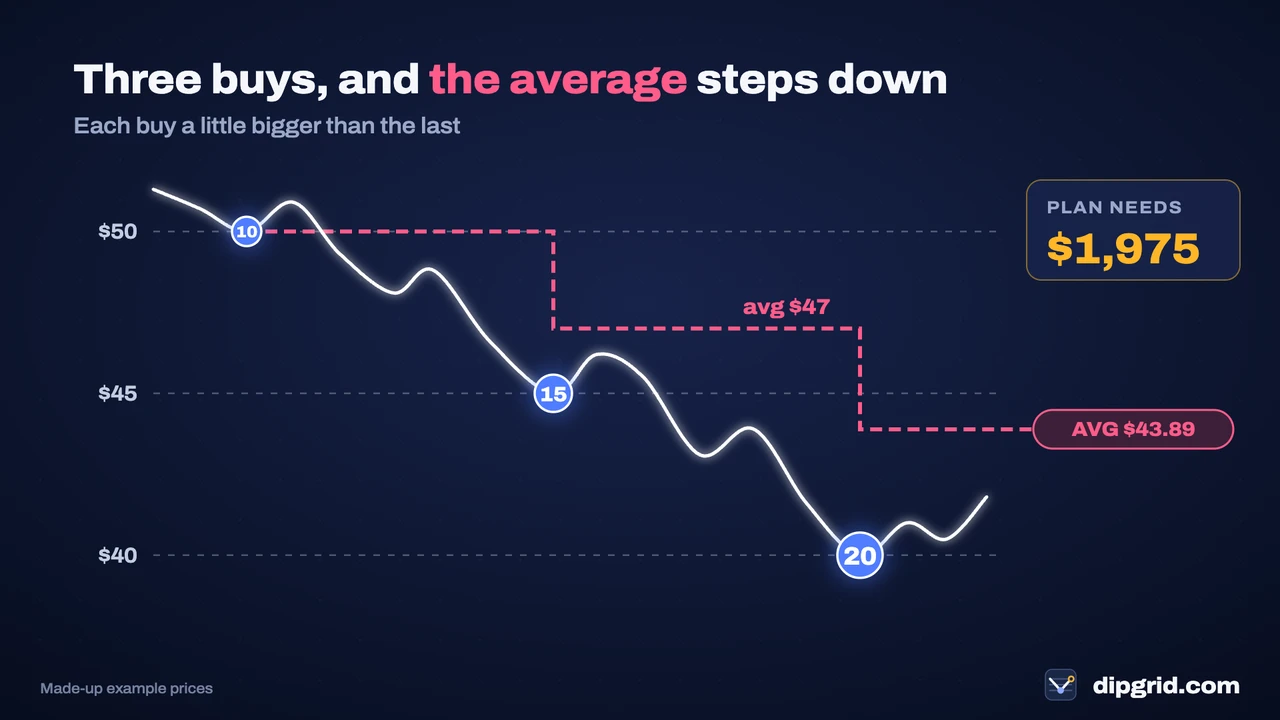
Three equal buys of 10 shares would cost $1,350 and end at a $45 average. The bigger ladder costs $625 more and lands at $43.89, so from $40 the stock needs about a 9.7% climb instead of 12.5%. You also hold 45 shares instead of 30, so every further move hits your account harder.
Write the plan down while you're calm: where you'll buy, how many shares, the lowest price you'll still add at, and what it all costs. Already holding the stock? Treat today's price as the first step and plan the next ones from there.
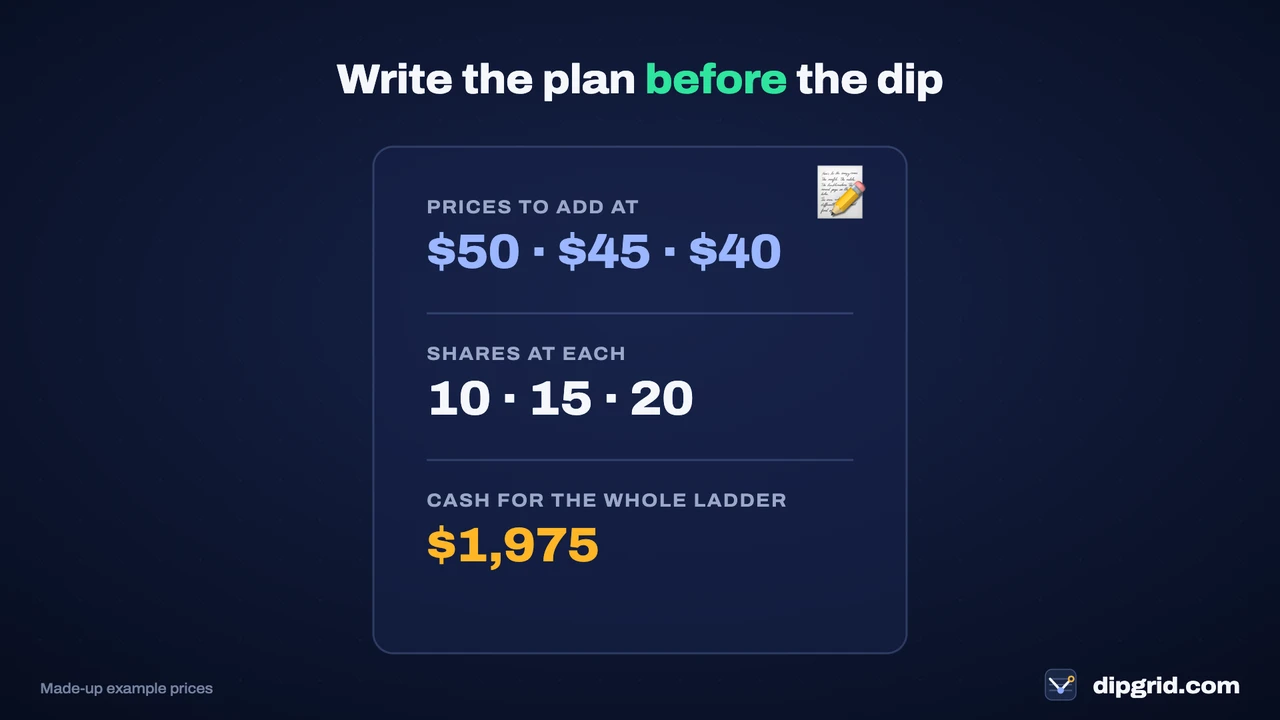
Most people don't stick to it. They freeze at $45, or give up halfway down.
Let a bot keep the plan
A DCA bot on DipGrid does this for you. Bot apps call it a DCA bot, though it follows the price rather than the calendar. It makes a first buy near today's price, then adds more shares at steps below if the price keeps falling. You set how many adds there are, how far apart they sit, and whether each one buys more than the last. When the price climbs a set percent above the bot's average, it sells everything it bought in one order and can start over.
Before you start, the bot shows how deep a drop your plan covers. It never spends more than the money you give it. The shares you already hold stay yours: the bot counts only the shares it buys itself and never sells more than that. It runs on our server and trades in your own brokerage account, during the hours you choose, so you don't have to be at the screen when the dip comes.
A grid bot also trades the bounces. Each share it buys goes up for sale one step higher, and when the price dips back, it buys that step again. Each of those small profits lowers your real cost. Our grid bot guide shows it with numbers.
This bot and others are on dipgrid.com. You can watch one work on made-up prices there, no sign-up.
Questions people ask
What does averaging down mean?
Buying more shares of a stock you already own after its price has fallen. The new shares cost less, so the average price of all your shares goes down.
How do I calculate my average cost?
Add up everything you paid for the shares you hold and divide by the number of shares. 5 shares at $80 and 15 at $60 cost $1,300 for 20 shares, so the average is $65.
Does averaging down lower my break-even?
Yes. Before fees and taxes, your break-even is your average cost. A lower average means the stock has less distance to climb before you're back to even.
Should I average down on a losing stock?
That's your call, and we don't recommend stocks. If you do, plan the buys and the cash before you place them, and pick the lowest price you'd still add at.
Is averaging down the same as dollar-cost averaging?
Not quite. Classic dollar-cost averaging buys the same dollar amount on a schedule, every week or month, whatever the price. Averaging down is about price: you buy more because the price fell. The DCA bot on DipGrid follows the price too.
Do fees change the math?
A little. Fees add to what you paid, so your real break-even sits slightly above your average cost. Taxes matter when you sell, and the rules have wrinkles, so check them for your own account. The examples here leave both out to keep the numbers clean.